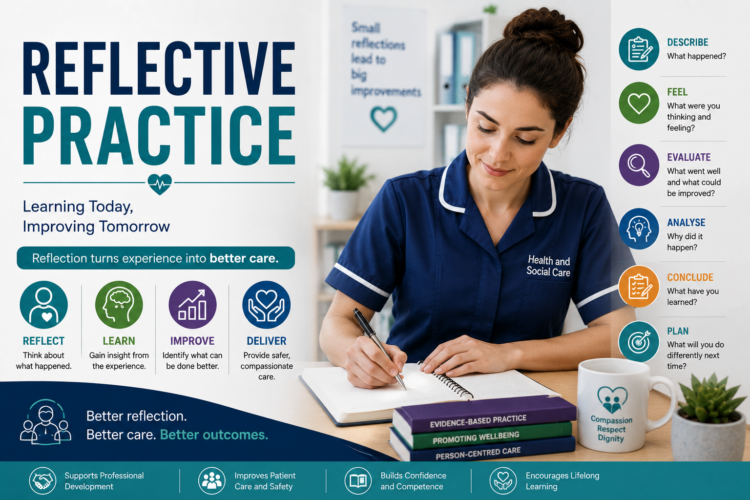
Reflective Practice in Health and Social Care
Reflective practice in health and social care plays a vital role in improving professional performance, patient safety, and care quality improvement. Healthcare professionals regularly encounter complex situations that require careful decision-making, compassionate care delivery, and continuous learning. Through structured reflective writing, reflective journaling, and reflective case discussions, practitioners can evaluate their experiences and identify areas for growth. Models such as the Gibbs reflective framework and Kolb experiential learning cycle help staff analyse actions, emotions, and outcomes in a structured way. Reflective practice also supports evidence-based practice, leadership development in healthcare, and workplace learning in care settings. By learning from clinical incidents and feedback evaluation, professionals can strengthen workforce competency and maintain healthcare professional standards. In both healthcare and social care environments, reflective practice encourages self-assessment techniques and professional accountability while supporting continuous Healthcare professional development and improved patient outcomes.
Understanding Reflective Practice
Reflective practice refers to the process of carefully examining workplace experiences to improve future actions and professional performance. In health and social care settings, professionals frequently encounter situations that require emotional intelligence, clinical judgment, and ethical decision-making. Reflective practice allows individuals to evaluate their responses, identify areas for improvement, and strengthen professional knowledge. This process can involve reflective journaling, reflective documentation, or peer-led reflective meetings where staff openly discuss challenges and solutions. Reflective activities also encourage self-awareness and help practitioners recognize how their actions affect patients, colleagues, and care outcomes. As healthcare systems place greater emphasis on accountability and evidence-based practice, reflective practice has become an important part of Healthcare professional development and workforce competency improvement.
Reflective Models in Healthcare Learning
Gibbs Reflective Framework
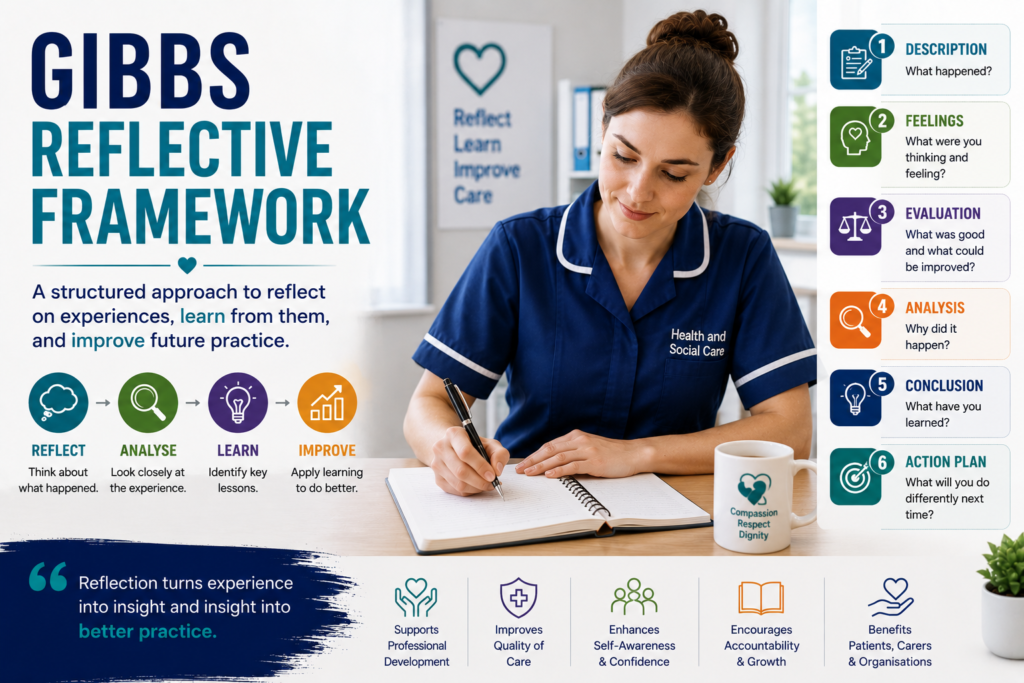
The Gibbs Reflective Framework is one of the most widely used models for reflective practice in health and social care education. Developed by Graham Gibbs in 1988, the framework helps learners and professionals examine experiences in a structured and meaningful way. Reflective practice is important because it encourages individuals to learn from real-life situations, improve decision-making, and develop professional skills. In health and social care settings, learners often face challenging situations that involve communication, teamwork, patient care, and ethical responsibilities. The Gibbs Reflective Framework provides a step-by-step process that helps learners understand what happened, how they felt, what went well, and what could be improved in future situations. By using this reflective model, learners can strengthen critical thinking skills, improve professional confidence, and support continuous learning. The framework is also commonly used in nursing, social care training, and clinical placements because it encourages self-awareness and accountability. As healthcare environments continue to evolve, reflective learning remains essential for improving professional standards and delivering high-quality patient care.
What Is the Gibbs Reflective Framework?
The Gibbs Reflective Framework is a structured model used to help individuals reflect on experiences and improve future practice. It is especially valuable in health and social care because professionals regularly encounter situations that require careful evaluation and learning. Reflection allows learners to think critically about their actions, communication methods, and decision-making processes. Unlike simple observation, reflective practice encourages deeper analysis of emotions, outcomes, and professional behaviour. The framework is commonly used during healthcare training because it supports both academic development and workplace learning. Learners who use reflective models consistently are often better prepared to handle complex care situations and improve patient interactions over time.
Stages of the Gibbs Reflective Cycle
Overview of the Framework
|
Stage |
Purpose |
|
Description |
Explains what happened during the situation |
|
Feelings |
Identifies thoughts and emotions experienced |
|
Evaluation |
Examines what went well and what did not |
|
Analysis |
Explores why the situation happened |
|
Conclusion |
Identifies lessons learned from the experience |
|
Action Plan |
Explains how future practice can improve |
The Gibbs Reflective Cycle follows six stages that guide learners through the reflective process. The first stage focuses on describing the event clearly and objectively. Learners are encouraged to explain the situation without making assumptions or judgments. The second stage explores personal feelings and emotional responses, helping learners understand how emotions may affect professional practice. During the evaluation stage, learners examine both positive and negative aspects of the experience. This helps identify successful actions as well as mistakes or challenges that require improvement.
The analysis stage encourages deeper thinking about why events occurred and how different actions may have changed the outcome. Learners often connect theory, policies, or communication strategies to the situation during this part of reflection. The conclusion stage focuses on lessons learned and areas for personal development. Finally, the action plan outlines practical steps for improving future performance. This final stage is important because reflective practice should lead to meaningful changes in behaviour and professional growth.
Benefits of Using the Gibbs Reflective Framework
Professional and Academic Advantages
The Gibbs Reflective Framework provides many benefits for health and social care learners. One major advantage is the development of critical thinking skills. Reflection encourages learners to analyse situations carefully rather than reacting emotionally or making assumptions. This helps improve problem-solving abilities and professional judgment in clinical environments. Reflective practice also strengthens communication skills because learners become more aware of how their interactions affect patients, families, and colleagues.
Another important benefit is increased self-awareness. By regularly reflecting on experiences, learners can identify personal strengths and areas needing improvement. This process supports confidence building and professional accountability. Reflective learning also improves academic performance because learners are able to connect classroom theory with practical experiences during placements or training activities. In healthcare environments where patient safety and ethical care are priorities, reflective practice helps learners become more responsible and compassionate professionals.
Common Challenges for Learners
Although the framework is highly effective, some learners may find reflective writing difficult at first. Discussing mistakes or emotional experiences can feel uncomfortable, especially during early training. Some learners also struggle to analyse situations deeply and may focus only on describing events rather than evaluating them critically. Time management can also be a challenge because reflective assignments often require detailed thinking and careful writing. However, with practice and guidance, learners usually become more confident in using the framework effectively.
Applying the Gibbs Reflective Framework in Health and Social Care
The Gibbs Reflective Framework is widely used during clinical placements, practical assessments, and professional training programs. Learners often apply the model after patient interactions, teamwork situations, or challenging care experiences. For example, a nursing student may use the framework to reflect on communication with a patient who was experiencing anxiety. By analysing the situation step by step, the student can identify successful communication techniques and areas where improvements are needed.
Healthcare educators encourage reflective practice because it supports continuous professional development and lifelong learning. Reflection helps learners understand the importance of empathy, professionalism, and ethical decision-making in care settings. It also encourages learners to take responsibility for their actions and actively improve their skills. As learners progress in their careers, reflective frameworks continue to play an important role in professional practice, leadership development, and patient-centred care improvement.
Kolb Experiential Learning Cycle
Understanding the Kolb Experiential Learning Cycle
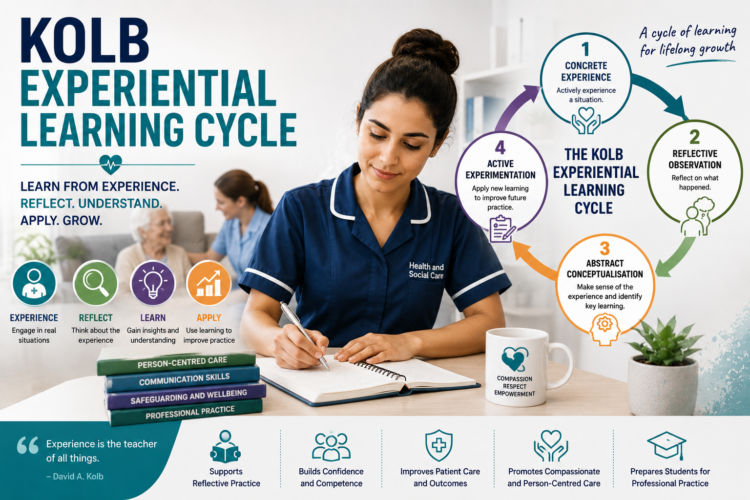
The Kolb Experiential Learning Cycle is a learning theory that focuses on gaining knowledge through experience and reflection. Unlike traditional learning methods that rely mainly on reading or lectures, Kolb’s model emphasizes active participation and personal involvement in the learning process. In health and social care education, this approach is especially important because learners must apply theoretical knowledge to real-life care situations. Experiential learning helps learners understand how their actions, decisions, and communication methods influence patient care and professional practice.
The cycle encourages continuous learning by guiding learners through a repeated process of experiencing, reflecting, thinking, and applying new knowledge. This allows healthcare learners to improve practical skills while developing critical thinking and self-awareness. The model is commonly used during clinical placements, practical assessments, and workplace learning activities because it supports both academic and professional development.
Stages of the Kolb Experiential Learning Cycle
Overview of the Learning Cycle
|
Stage |
Purpose |
|
Concrete Experience |
Involves actively experiencing a situation |
|
Reflective Observation |
Encourages reflection on the experience |
|
Abstract Conceptualization |
Develops understanding and theoretical ideas |
|
Active Experimentation |
Applies new learning to future situations |
The first stage, concrete experience, involves direct participation in an activity or situation. In healthcare education, this could include interacting with patients, participating in teamwork activities, or observing clinical procedures. Learners gain practical experience that becomes the foundation for future learning. The second stage, reflective observation, focuses on reviewing the experience carefully. Learners think about what happened, how they responded, and what outcomes occurred during the situation.
The third stage, abstract conceptualization, encourages learners to connect their experiences with theories, policies, or professional knowledge. During this stage, learners analyse why events happened and identify lessons that can improve future practice. The final stage, active experimentation, involves applying newly gained knowledge in future situations. Learners test different approaches, communication methods, or problem-solving strategies to improve outcomes. Because the cycle is continuous, learners can repeatedly build on experiences and strengthen professional competence over time.
Benefits of the Kolb Learning Cycle in Health and Social Care
Supporting Student Development
The Kolb Experiential Learning Cycle offers many advantages for health and social care learners. One major benefit is the improvement of practical learning. Learners are able to apply classroom knowledge directly to workplace experiences, which strengthens understanding and confidence. This learning approach also improves critical thinking because learners are encouraged to analyse situations carefully rather than simply memorizing information. Reflection allows learners to identify mistakes, recognize strengths, and develop more effective professional behaviours.
Another important advantage is improved communication and teamwork skills. Healthcare environments require professionals to work closely with patients, families, and colleagues. Experiential learning helps learners understand how their communication style affects others and encourages more compassionate care practices. The cycle also promotes self-awareness and adaptability, which are essential in fast-changing healthcare settings. By continuously learning from experiences, learners become more prepared to manage challenging situations and provide safe, effective care.
Challenges of Experiential Learning
Although experiential learning is highly effective, some learners may struggle with reflective analysis or applying theory to practice. Certain learners may feel uncomfortable discussing mistakes or evaluating their own performance critically. Time pressures during placements can also make detailed reflection difficult. Additionally, learners may require guidance from mentors or supervisors to fully understand how to apply the learning cycle effectively. Despite these challenges, regular practice and support can help learners gain confidence in reflective and experiential learning methods.
Applying Kolb’s Learning Cycle in Professional Practice
The Kolb Experiential Learning Cycle is widely used in healthcare education because it supports lifelong learning and continuous professional development. During clinical placements, learners often encounter situations involving patient communication, ethical dilemmas, or emergency care responsibilities. By applying the learning cycle, learners can reflect on these experiences and identify practical improvements for future situations. This process helps learners become more adaptable and professionally responsible.
Healthcare educators encourage experiential learning because it prepares learners for real-world challenges and supports evidence-based practice. Reflection and experimentation help learners develop stronger problem-solving abilities and improve patient-centred care. As learners progress in their careers, the Kolb model continues to support leadership development, workplace learning, and professional accountability. In modern health and social care settings, experiential learning remains an essential tool for improving both individual performance and overall care quality.
