Entry requirements and workplace setting (what you usually need)
Because Level 5 is work-based, you normally need:
- A leadership role in an adult care setting (residential, domiciliary, supported living, etc.)
- Access to service processes (supervision, audits, policies, staffing, quality improvement activity)
- Opportunities to demonstrate leadership decisions and outcomes
- A manager/organisation that can support evidence gathering and (where required) observation
Providers vary, so confirm early: expected responsibilities, evidence requirements, and the assessment method.
How RQF Level 5 is Assessed (Evidence-based Leadership)
Most Level 5 programmes are assessed through evidence and professional discussion rather than written exams. Assessors typically look for proof that you can lead safely and effectively.
Common Assessment Methods include:
Leadership Portfolio Evidence
A structured portfolio showing you can meet criteria through real work: planning, leading, improving, and evaluating.
Professional Discussions (PD)
Structured conversations where you explain your leadership decisions, justify actions, and demonstrate understanding of frameworks, policies, and responsibilities.
Workplace Observation (where applicable)
Some programmes may observe aspects of leadership practice (meetings, supervision approach, communication, professional behaviours). Requirements vary by provider.
Work Products (anonymised)
Examples of leadership outputs can be powerful evidence, such as:
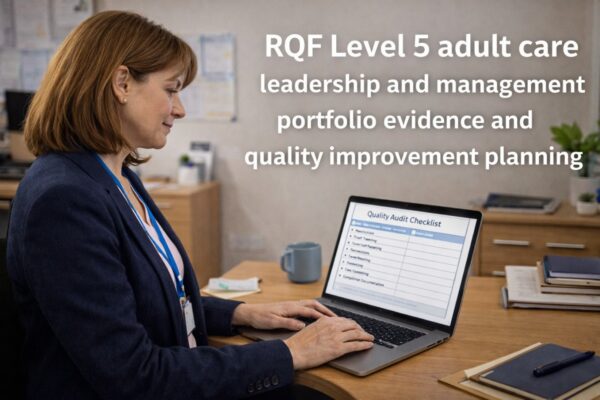
- Audit tools and completed audits (redacted)
- Supervision templates and action plans (redacted)
- Staff meeting agendas/minutes (redacted)
- Training matrices and compliance trackers
- Risk assessment reviews and improvement plans
- Policies/procedures you reviewed or implemented
- Quality improvement plans and outcome reports
Important: never include service user names, staff personal data, or identifiable information in evidence.
Evidence Types Assessors Expect (what “good Level 5 evidence” looks like)
At Level 5, evidence must show leadership impact, not just activity. Strong evidence usually includes:
- Decision-making with rationale
What decision you made, why, what you considered (risk, policy, safeguarding, capacity), and what changed afterwards.
- Managing people and performance
Evidence of supervision, feedback, support plans, coaching, delegation, and accountability.
- Quality improvement and governance
Audits, outcomes, actions taken, follow-up, and measurable improvement.
- Compliance and safe systems
How you ensure safe practice across a service: medication oversight, incident reporting, safeguarding processes, training compliance, documentation standards.
- Partnership and communication
How you work with professionals, families (appropriately), commissioners, and internal stakeholders.
Common Level 5 Challenges (and how to fix them)
- “My evidence is too descriptive.”
Fix: always show impact. Include outcomes, measures, and what changed because of your leadership.
- “I’m busy managing the service, but I’m not capturing evidence.”
Fix: build a weekly evidence capture routine (15 minutes) and save redacted work products as you go.
- “I don’t know what’s ‘good enough’ for Level 5 writing.”
Fix: use a management structure: context → risk/standards → decision → action → outcome → evaluation → improvement.
- “I’m worried about plagiarism or sounding generic.”
Fix: Level 5 is safest when it’s specific. Use your real service context, real decisions, and real outcomes. Avoid copied templates that don’t reflect what you actually do.
Step-by-step plan to complete RQF Level 5 (repeatable)
Step 1: Map your Role to the Qualification Outcomes
List your responsibilities (supervision, audits, staffing, incidents, training, care planning oversight, etc.) and identify where evidence will come from.
Step 2: Create an Evidence Bank
Set up folders for: audits, supervision, meetings, training compliance, incidents, improvement plans, and PD notes (all anonymised).
Step 3: Choose One Unit at a time
For each learning outcome, select the best evidence type: work product + reflection + PD notes is often the winning combination.
Step 4: Write Leadership Reflections that Show Impact
Use a consistent structure:
-
- What was the issue?
- What risks/standards applied?
- What decision did I make and why?
- What actions did I take?
- What changed (outcome)?
- How did I evaluate it?
- What will I improve next?
Step 5: Prepare for Professional Discussion
Create STAR-style answers using your real leadership examples (staff performance, safeguarding escalation, audit improvement, incident learning, complaints handling, etc.).
Step 6: Review for integrity and confidentiality
Remove identifiers. Ensure it is your work, your decisions, your context, and you can defend it.
Step 7: Submit Consistently and Track Progress
Use a monthly tracker so you always know what’s completed, what’s missing, and what’s next.
Plagiarism-safe Rules (especially if you use AI)
Support is allowed when it helps you learn and structure your thinking. It becomes unsafe when it writes leadership content you then submit.
You can use AI Safely For:
- Planning and outlining unit responses
- Turning your notes into a clearer structure (without adding new facts)
- Creating PD practice questions
- Identifying “what evidence could I use?” prompts
Do Not Use AI to:
- Generate full unit answers for submission
- Invent management actions, audits, or outcomes
- Produce generic leadership paragraphs you can’t evidence
A practical Level 5 rule: if you can’t show an anonymised work product or explain the real outcome behind a paragraph, don’t submit it.