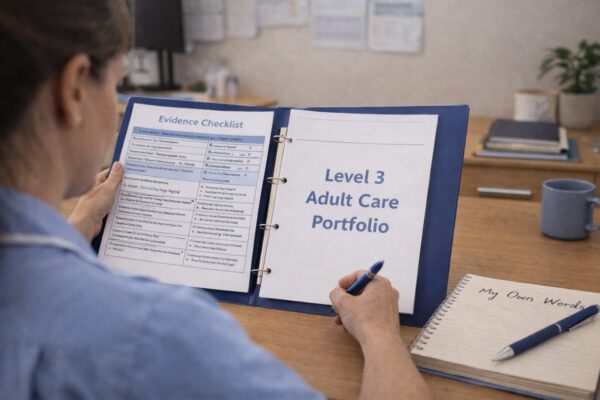
RQF Level 3 Diploma Adult Care

RQF Level 3 Adult Care: From Care Worker to Senior Carer

The RQF Level 3 Diploma in Adult Care is one of the most recognised work-based qualifications for care workers in the UK. It’s designed for people already working in care who want to increase competence, confidence, and responsibility in their role—and progress towards senior positions.

This guide explains what Level 3 involves, how you’re assessed (evidence-based, not exams), the types of evidence assessors expect, and how to complete your portfolio without risking plagiarism or misconduct.

What is the RQF Level 3 Adult Care Qualification?

RQF Level 3 Adult Care is a regulated, work-based qualification focused on real practice. Rather than exams, you show competence through your day-to-day work, reflection, and discussion with your assessor.

Most learners are assessed through:

  • Workplace evidence (real work products and practice examples)
  • Reflective accounts (what you did, why, and what you learned)
  • Assessor observations (practice demonstrated on shift)
  • Professional discussions (structured Q&A with your assessor)

Important: Although there are no written exams, Level 3 requires more depth than Level 2. Assessors expect clear links between what you did in practice and the principles, policies, and responsibilities behind your actions.

Who is Level 3 Adult Care for?

Level 3 is typically suitable if you:

  • Work as a care worker, support worker, senior carer, or similar role
  • Have Level 2 already, or equivalent workplace experience
  • Are expected to take more responsibility (risk awareness, mentoring others, documentation quality)
  • Want to progress to senior roles, supervision, or Level 4/5 pathways

If you’re new to care, Level 2 (or the Care Certificate) is usually a better starting point.

Units and learning Outcomes Explained (simple)

Your course is broken into units. Each unit has learning outcomes and assessment criteria. This is what your assessor uses to judge whether your evidence is strong enough.

Most Level 3 themes include:

  • Person-centered practice and dignity
  • Safeguarding responsibilities and reporting
  • Communication and partnership working
  • Duty of care and boundaries
  • Health, safety and well being

Supporting individuals with specific needs (depending on your role)

The fastest way to fall behind is collecting “general evidence” that doesn’t clearly match the criteria. The winning approach is evidence mapping: planning exactly what you’ll use for each learning outcome before you write.

Types of evidence assessors expect (and how to do each one)

Reflective Accounts

These are not stories. A strong reflective account explains:

  • What happened (brief facts)
  • What you did (step-by-step)
  • Why you did it (policy, values, duty of care)
  • Outcome (what changed)
  • What you learned and what you’d do next time

Workplace Observations

Your assessor watches you demonstrate competence in real tasks (communication, dignity, safe practice, risk awareness). Preparation matters: know what criteria the observation is meant to cover and gather supporting evidence ready.

Professional Discussions (PD)

These are structured conversations to confirm your knowledge and decision-making. Good PD prep uses real examples from your workplace and clear terminology (safeguarding, MCA, best interests, confidentiality, etc.).

Internal link suggestion:
Book 1:1 support (PD prep / evidence mapping) → /book-1-1-coaching/

Common Level 3 challenges (and How to Fix them)

Most learners struggle with:

  • Understanding criteria wording (“explain”, “describe”, “analyse”)
  • Writing at the right depth (too descriptive, not reflective)
  • Linking practice to policy/legislation without sounding generic
  • Not capturing evidence in real time (then rushing at deadlines)
  • Fear of accidental plagiarism (copying online phrasing or AI output)

Fix: Use a repeatable routine that captures evidence weekly, then builds it into assessor-ready writing.

A simple step-by-step plan to pass Level 3 (without overwhelm)

Step 1: Choose one unit at a time and list the learning outcomes.
Step 2: For each learning outcome, decide your evidence type (reflection, observation, PD, work product).
Step 3: Capture 2–3 real workplace moments per week (short notes are enough).
Step 4: Draft in your own words using a structure (principles → example → reflection → outcome).
Step 5: Check it sounds like you, and that you can explain it if asked.
Step 6: Submit consistently, not perfectly.

Plagiarism-safe rules (especially if you use AI)

Assessors want your own learning and your own practice. Support is allowed when it helps you understand and structure your work—not when it replaces your work.

Use AI Safely for:

  • Explaining criteria in plain English
  • Creating outlines and checklists
  • Improving clarity of your own draft

Do not use AI for:

  • Copy/paste answers
  • Invented workplace scenarios
  • Generic paragraphs you can’t explain

How Care Worker Hub Supports Level 3 Learners (Safely)

Care Worker Hub helps you progress by:

  • Breaking down unit criteria into plain English
  • Helping you plan evidence before you write
  • Teaching you how to reflect (not what to write)
  • Providing plagiarism-safe AI tools and coaching designed for care qualifications


Recommended plan for Levels 3 Learners: Premium Plan (fortnightly study time + pathway webinars), or Professional Plan if you want priority 1:1 support.

Progression After Level 3

Once you complete Level 3, many care workers progress to:

  • Senior care worker / team leader roles
  • Lead Practitioner pathways (where available)
  • Level 4/5 Leadership and Management
  • Specialist routes (safeguarding, dementia, LD, autism, medication, etc.)

FAQs

How is RQF Level 3 is Assessed?

It’s evidence-based. You’re usually assessed through workplace evidence, reflective accounts, observations, and professional discussions (no written exams).

Do I need a Workplace Placement?

Level 3 is typically work-based, so you usually need to be in a care role where evidence and observation can take place.

Can I get help with assignments?

You can get guidance on criteria, structure, evidence mapping, and clarity. You must still write and submit your work in your own words.

Can I use AI tools?

Yes, if used ethically—for planning and clarity. Avoid copying AI-generated paragraphs into submissions.