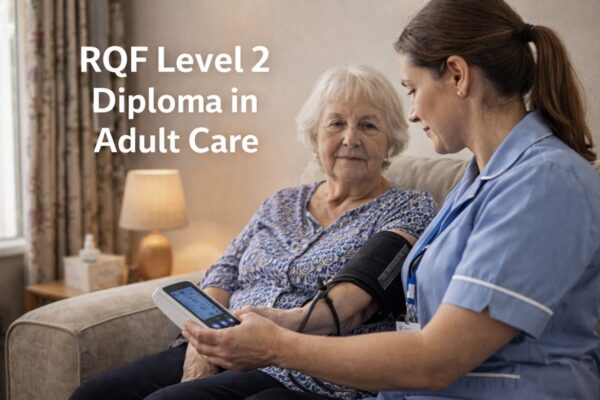
How to Complete RQF Level 2 Diploma in Adult Care Successfully.

The RQF Level 2 Diploma in Adult Care is one of the most common work-based qualifications for care workers in the UK. It helps you build core competence, confidence, and safe practice in real care settings—often without exams. Instead, you usually complete a portfolio of evidence and demonstrate skills in the workplace.

This guide explains what Level 2 involves, who it’s for, how you’re assessed, what evidence you need, common challenges, and how Care Worker Hub supports learners in a plagiarism-safe, assessor-friendly way.

What is the RQF Level 2 Diploma in Adult Care?

RQF Level 2 Adult Care is a regulated qualification focused on the foundations of good care. It typically covers essential areas such as communication, duty of care, safeguarding, health and safety, dignity, person-centered practice, and professional working.

Most learners are assessed through a portfolio approach rather than written exams. Your assessor gathers evidence that shows you can work safely and competently in your role.

Who is Level 2 Adult Care For?

Level 2 is usually suitable if you:

  • You are new to care or early in your care career
  • Work as a care assistant, support worker, or domiciliary care worker
  • Want a recognised qualification to strengthen your role and future opportunities
  • Need to show competence for workplace progression or compliance

If you’re already working at senior level or regularly mentoring others, Level 3 may be a better fit.
Entry Requirements and Workplace Placement (what most learners need)

Because Level 2 is work-based, most learners need access to a real care setting (paid or voluntary) so they can:

  • Gather evidence from day-to-day practice
  • Take part in professional discussions
  • Be observed carrying out tasks safely
  • Obtain witness testimonies or confirmation from a competent colleague/supervisor

Requirements vary by provider, so always confirm:

  • Whether you must be employed in care
  • Whether observations are required
  • What support period you get (e.g., 6–12 months)

How Level 2 is Assessed (no exams – evidence-based)

Level 2 is commonly assessed using a mix of:

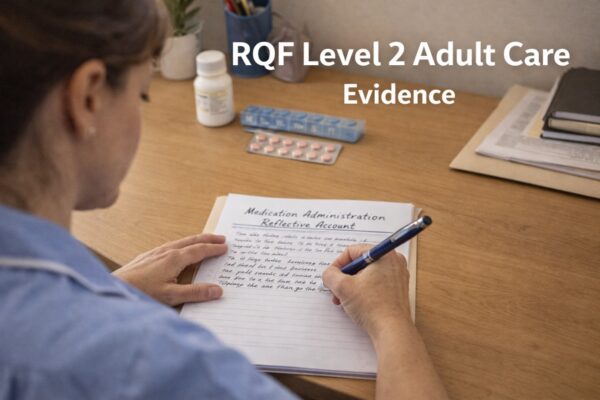
Reflective Accounts

Short, clear writing that explains what you did, why you did it, and what you learned. At Level 2, assessors often want “clear and correct” rather than long academic writing.

Workplace Observations

Your assessor may observe core tasks and professional behaviours such as communication, dignity, infection prevention, safe moving and handling, record-keeping standards, and risk awareness.

Professional Discussions (PD)

Structured Q&A where you explain your knowledge and decision-making. The best PD answers link to real workplace examples, not theory alone.

Work Products (where appropriate)

This can include non-confidential examples of documents you contribute to (e.g., anonymised care planning evidence, risk awareness notes, shift note’s structure) depending on provider rules.

Evidence Types Assessors Expect (and examples of what “good” looks like)

The simplest way to stay on track is to plan evidence types upfront. A strong Level 2 portfolio usually includes:

  • 2–3 workplace examples per unit (real situations you were involved in)
  • Reflective accounts using a simple structure (facts → action → outcome → learning)
  • Observation evidence (if required)
  • PD notes or prep responses
  • Witness testimonies (when suitable)

A strong workplace example should show:

  • What happened (brief facts)
  • What you did (steps)
  • Why (duty of care / policy / safety)
  • Outcome (what changed)
  • Reflection (what you learned)

How Long Does Level 2 Take?

Many learners complete Level 2 within 6–12 months, depending on:

  • How many hours you work in care
  • Assessor availability for observation/PD
  • How consistently you capture evidence
  • How quickly you submit each unit

The fastest route is consistency—small weekly evidence capture beats last-minute writing.

Common Challenges for Level 2 Learners (and how to fix them)

  1. “I don’t know what the learning outcome means.”
    Fix: break it into plain English and map it to evidence before writing.
  2. “I’m doing the work but I’m not collecting evidence.”
    Fix: use a daily or weekly evidence capture habit (2–5 minutes after shifts).
  3. “My writing is too short or too general.”
    Fix: add a real workplace example and a brief reflection: what you did, why, outcome.
  4. “I’m worried about plagiarism or using AI wrongly.”
    Fix: use AI only for planning and clarity, then write your final submission in your own words.

A simple step-by-step plan to complete Level 2 (repeatable)

Step 1: Choose one unit and list the learning outcomes.
Step 2: Decide your evidence type for each outcome (reflection, PD, observation, witness).
Step 3: Capture 2–3 real workplace examples per week.
Step 4: Write short, clear reflective accounts in your own words.
Step 5: Prepare for PD using your examples (what you did and why).
Step 6: Final check: authenticity, clarity, and criteria coverage.
Step 7: Submit and move to the next unit.

Plagiarism-Safe Rules (especially if you use AI)

Support is allowed when it helps you learn and structure your work—not when it replaces your work. You can use tools for:

  • Explaining criteria in plain English
  • Creating outlines and checklists
  • Improving clarity of your own draft

Do not:

  • Copy/paste AI-generated answers
  • Submit generic paragraphs you can’t explain
  • Invent workplace examples

How Care Worker Hub supports Level 2 Learners

Care Worker Hub supports Level 2 learners by:

  • Simplifying learning outcomes and showing what assessors look for
  • Providing templates to capture workplace evidence quickly
  • Offering clinics, study sessions, and 1:1 coaching depending on your plan
  • Keeping everything plagiarism-safe and learner-led

Recommended Next Steps:

  • Start with the Free 7-Day Quick Win Plan if you feel stuck
  • Join Starter for monthly clinics and evidence templates
  • Choose Premium for fortnightly study sessions + pathway webinars
  • Use Professional if you want priority support and coaching

Progression after Level 2

After Level 2, many learners progress to:

  • Level 3 Diploma in Adult Care
  • Senior care worker or team leader pathways (often alongside Level 3)
  • Specialist CPD pathways (dementia, safeguarding, autism, medication)
  • Apprenticeship routes depending on employer support

Progress to Level 3 Adult Care

FAQs

Is Level 2 the same as the Care Certificate?

No. The Care Certificate is an induction standard. Level 2 is a regulated qualification assessed through workplace evidence and (often) observation/PD.

Do I need to be working in Care to do Level 2?

Usually yes, because you need a workplace setting to gather evidence and demonstrate competence.

Are there exams for Level 2 Adult Care?

Typically no. Most programmes are portfolio and evidence based, but provider requirements can vary.

What evidence do I need for Level 2?

A mix of reflective accounts, workplace examples, PD answers, and (where required) observation and witness testimony.

Can I get help with my assignments?

Yes—support with criteria, structure, and evidence mapping is usually acceptable. Your final submission must be your own work in your own words.

Can I use AI tools?

Yes, if used ethically for planning and clarity. Avoid copying AI-generated content into your submission.
